

What is prevention?

What makes prevention possible
Prevention means building supportive schools, workplaces, families and communities, reducing the social and economic pressures that can undermine mental health, and strengthening the protective factors that help people navigate life’s challenges.
Many mental health conditions can be prevented. The evidence is clear. When we act early on the factors that shape mental health, we can reduce harm and strengthen wellbeing.
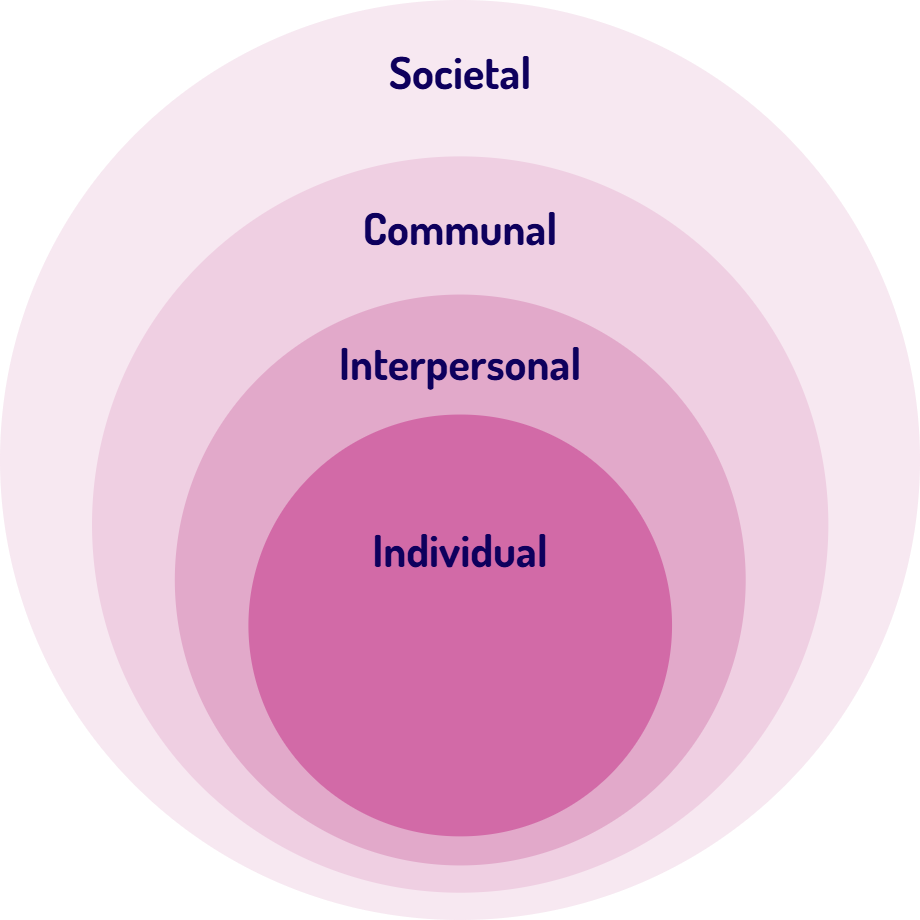
Adapted from Bronfenbrenner, U. (1979). The Ecology of Human Development: Experiments by Nature and Design. Harvard University Press.
Social, economic, and cultural influences that shape the conditions in which we live
Communal influences that affect how we feel in the places where we live, learn, work and play
Interpersonal influences that affect the nature and quality of relationships with the people closest to us
Individual influences such as genetics, personality traits, experiences and health behaviours
Prevention isn’t about avoiding life’s challenges.

Where prevention sits
Acts before conditions develop
Reaches everyone
Reaches people with early signs
intervention
Responds as a condition emerges
Provides care for mental health conditions
Shaded: where Prevention United plays a role
Key facts and evidence
Source: [reference to be supplied by PU]
Source: [reference to be supplied by PU]
Source: [reference to be supplied by PU]
Source: [reference to be supplied by PU]
Source: [reference to be supplied by PU]
Frequently asked questions
The basics
Why do we need prevention?
What's the difference between mental wellbeing and mental ill-health?
Mental wellbeing and mental ill-health are related, but they’re not opposites. Wellbeing is about feeling good, functioning well, and coping with life’s inevitable challenges. Mental ill-health includes experiences like psychological distress and diagnosed conditions such as anxiety and depression.
Someone can live with a mental health condition and still experience high wellbeing. Someone with no diagnosis can be struggling. That’s why supporting both mental wellbeing and the prevention of mental health conditions matters.
Is prevention the same as early intervention?
What's the difference between mental health promotion and prevention?
Promotion focuses on improving mental wellbeing across the whole population. Prevention focuses on reducing the likelihood of mental health conditions developing. The two go hand in hand, because low wellbeing is a key risk factor for mental health conditions. That’s why Prevention United works across both, as part of a comprehensive system that also includes early intervention, treatment and recovery support.
For practitioners and community leaders
Who is responsible for prevention? Isn't that the job of health professionals?
Prevention isn’t only a health system responsibility. Many of the factors that shape mental health (belonging, financial security, safety, connection, and purpose) exist outside clinical settings.
Prevention requires action across the whole community. Schools, workplaces, sporting clubs, local councils, and community organisations all have an important role to play. Educators, employers, community leaders, urban planners and other policy makers are often well placed to influence the everyday environments where mental health is shaped.
What does prevention actually look like in practice?
Prevention can take many forms. It might be a school embedding social and emotional learning into the curriculum, a workplace designing roles that foster autonomy and connection, a local council creating safe public spaces or addressing housing insecurity, or a sporting club building a culture of psychological safety.
Prevention isn’t a single program or intervention. It’s about creating the conditions that support good mental health wherever people live, learn, work and connect.
Are there different types of prevention?
How do I know if a prevention initiative is actually working?
Evidence matters. Effective prevention initiatives are based on research, designed with clear outcomes in mind, and evaluated to understand their impact.
The good news is that prevention can be measured. Prevention United’s resources include practical guides to help organisations design and evaluate initiatives that make a real difference.
For government and policymakers
If we've been investing in mental health for decades, why are rates still rising?
Because we’ve focused far more on responding to mental ill-health than preventing it. Treatment and crisis support are essential, but they come into play after problems have already emerged.
If we want to reduce rates of mental ill-health across the population, we also need to address the social, economic and environmental conditions that shape mental health long before people reach a crisis point. That’s where prevention comes in.